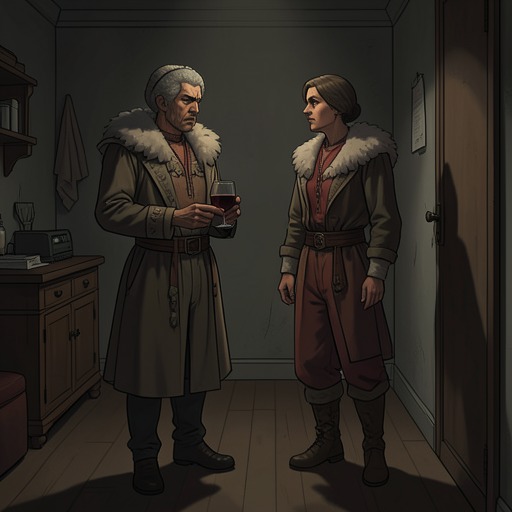
Robert Walters and Elizabeth Mourning-Walters' Marriage
I'm Still Here- What didn't kill me made me stronger and sharperRobert Walters and Elizabeth Mourning-Walters' marriage is a union whose public language of loyalty conceals years of infidelity, and whose collapse turns private betrayal into public scandal and violence. Robert presents himself as a devoted husband while pursuing Janae Morrison and other women; Elizabeth's eventual response is at once vengeful and marked by continuing love. Their marriage ends not in reconciliation but in Robert's death and Elizabeth's confession that she killed him.
Marriage and Public Image
Robert Walters invokes his marriage as proof of his respectability when he addresses the media. He denies having a personal relationship with Janae Morrison, insists that his loyalty to his wife is secure, and casts himself as a humanitarian trying to help a troubled young artist. In his account, Janae is the seducer and he is the benevolent figure who came to offer her alternatives. The performance gives the marriage a central place in his defense: its apparent stability is used to make the accusation of an affair seem implausible.
That image is reinforced by Elizabeth Mourning-Walters' standing in the community. Janae describes her as admired and socially influential, with a doctorate and a polished public presence. Robert's denial draws on the contrast between his wife and Janae, whom the media and community frame as an unlikely partner for him. The story exposes how status and appearance become a defense: Robert's respected position and Elizabeth's public image make Janae's account easier to dismiss, even though the affair is real.
The Affair and the Double Life
Robert's relationship with Janae begins at an event where she is showing and trying to sell her artwork. He approaches her, buys art supplies, pays for her art classes, and takes her to New York to see artists associated with the Harlem Renaissance. He also gives her repeated assurances that he loves her and finds her beautiful. Their relationship includes sex and drug use, while the portrait Janae paints for him remains in his office—a visible trace of a bond he later denies.
Elizabeth is not initially presented to Janae as the wife whose marriage is being betrayed. Instead, she befriends Janae, buys her clothes and shoes, and brings her into her high-society circle. Janae says she learns of the marriage at another art event, when Robert arrives with Elizabeth. She breaks off the affair, but Robert calls and texts, asks forgiveness, and insists that Janae remain part of his life. The contrast is central to the betrayal: Elizabeth's kindness and Robert's intimate promises occupy the same social world, while he conceals the marriage from Janae and then publicly reduces their relationship to business.
Janae also acknowledges her own role in the affair, describing herself as a homewrecker after learning that Robert was married. But her account makes clear that Robert pursued her, cultivated the relationship, and repeatedly drew her back after she tried to end it. His press-conference denial therefore does more than contradict her: it recasts the relationship as a one-sided attempt by a supposedly unstable woman to seduce a married man. The gap between that public story and Janae's detailed account reveals the marriage's place in Robert's double life—as both a real bond and a prop in his defense of his reputation.
Jealousy, Violence, and Death
Elizabeth's discovery of the affair does not remain a private marital conflict. She transfers $25,000 to the person she hires to kill Janae and hands over Janae's photograph. When asked why Janae must be eliminated, Elizabeth says that Janae has Robert's heart and that he is in love with her. Her explanation makes the intended killing an act of jealousy directed not simply at an affair, but at the emotional attachment she believes Robert has given another woman. The contract turns the triangle into a lethal consequence of the marriage's secrecy and divided loyalties.
The account of Robert's own death first reaches Janae through social media and news reports describing a self-inflicted gunshot wound. She then learns that Elizabeth has admitted shooting him. Elizabeth says she killed him because she was tired of his affairs and lies, naming the force behind the act as rage, hatred, anger, and love mixed together. Her explanation refuses a clean division between attachment and violence: she describes neither indifference nor simple hatred, but a marriage in which love persists within accumulated injury.
Aftermath and Meaning
In a televised interview, Elizabeth blames the women who slept with Robert for pursuing his status and money and for damaging the family. The interviewer challenges that account by raising the possibility that Robert used his power and that several women had not known he was married. Elizabeth ultimately says that he left both her and the other women broken, that they had all been fooled, and that she forgives them. Her response does not erase her betrayal of Janae's friendship or her attempt to have Janae killed; it reveals a late recognition that Robert's deception implicated more than one woman.
The marriage thus shapes the story through the collision of public respectability with concealed conduct. Robert appeals to marital loyalty when it protects him, while his repeated affairs undermine the very image he invokes. Elizabeth's actions move from social friendship with Janae, to an attempt to remove her as a rival, to a confession and an expression of forgiveness toward the women caught in Robert's pattern of deception. Their marriage ends in death, but its aftermath shifts attention from the polished public couple to the damage left among the people bound together by Robert's lies.